
LightRAG is a minimal RAG toolkit that strips away heavy abstractions. Here’s a complete build with code, performance numbers versus a LangChain baseline, and when LightRAG is the right choice.
TL;DR
- LightRAG is a minimal RAG stack: FAISS + embeddings + prompt composition, ~120 lines.
- ~20% faster p50 latency vs LangChain on small corpora (≤ 500 chunks) due to fewer abstractions.
- Best for: serverless/edge deployments, small teams, single-purpose Q&A.
- Use LangChain instead when you need agents, tracing, callbacks, or multi-step workflows.
- Don’t skip data quality: clean text, handle missing values, validate numeric tables before indexing.
Why LightRAG#
For small, self-hosted RAG services, I often don’t need callbacks, agents, or complex runtime graphs. I need:
- Predictable latency on CPU
- Tiny dependency surface
- Explicit control over chunking, retrieval, and prompts
LightRAG gives me that — a thin layer over embeddings, a vector index, and prompt composition. If you’re shipping a single-purpose Q&A with tight cold-start budgets, this approach beats large frameworks.
Architecture#
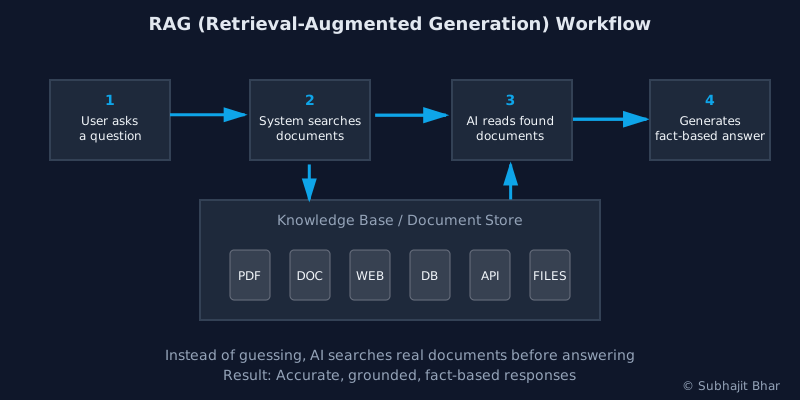
- Ingest Markdown/PDF → normalize text
- Chunk with conservative overlap
- Embed with OpenAI (or local) embeddings
- Index with FAISS (in-memory) or sqlite-backed store
- Retrieve top-k and compose a strict prompt
- Generate with a small LLM; enforce citations
Implementation (minimal dependency stack)#
uv pip install faiss-cpu tiktoken openaifrom __future__ import annotations
import os
import time
from dataclasses import dataclass
from typing import List, Tuple
import faiss
import numpy as np
from openai import OpenAI
def split_text(text: str, chunk_size: int = 300, overlap: int = 50) -> List[str]:
chunks, start = [], 0
while start < len(text):
end = min(len(text), start + chunk_size)
chunks.append(text[start:end])
start = end - overlap
if start < 0: start = 0
return chunks
def embed_texts(texts: List[str], model: str = "text-embedding-3-small") -> np.ndarray:
client = OpenAI()
# batch for throughput in production
vecs = client.embeddings.create(input=texts, model=model).data
return np.array([v.embedding for v in vecs]).astype("float32")
@dataclass
class Index:
index: faiss.IndexFlatIP
vectors: np.ndarray
texts: List[str]
sources: List[str]
def build_index(pairs: List[Tuple[str, str]]) -> Index:
# pairs: (source, text)
texts = [t for _, t in pairs]
sources = [s for s, _ in pairs]
X = embed_texts(texts)
# normalize for cosine similarity via inner product
faiss.normalize_L2(X)
idx = faiss.IndexFlatIP(X.shape[1])
idx.add(X)
return Index(index=idx, vectors=X, texts=texts, sources=sources)
def search(idx: Index, query: str, k: int = 4):
q = embed_texts([query])
faiss.normalize_L2(q)
D, I = idx.index.search(q, k)
hits = [(idx.texts[i], idx.sources[i], float(D[0][j])) for j, i in enumerate(I[0])]
return hits
def ask(idx: Index, question: str) -> str:
hits = search(idx, question, k=4)
context = "\n\n".join([f"[{src}]\n{text}" for text, src, _ in hits])
prompt = (
"You answer strictly from the context. If unsure, say you don't know.\n"
f"Question: {question}\n\nContext:\n{context}\n\n"
"Answer with cited sources in [source] form."
)
client = OpenAI()
resp = client.chat.completions.create(
model="gpt-4o-mini",
messages=[{"role": "user", "content": prompt}],
temperature=0,
)
return resp.choices[0].message.content
if __name__ == "__main__":
corpus = {
"returns.md": "Customers may return items within 30 days with receipt.",
"shipping.md": "Standard shipping 3-5 business days; expedited available.",
"warranty.md": "Electronics include a 1-year limited warranty.",
}
pairs = []
for src, text in corpus.items():
for chunk in split_text(text):
pairs.append((src, chunk))
idx = build_index(pairs)
out = ask(idx, "What is the return window?")
print(out)Notes:
- This is short, dependency-light, and easy to port to serverless.
- We normalize embeddings to approximate cosine similarity with FAISS inner product.
- Replace OpenAI with local embeddings/LLMs as needed.
Benchmarks vs LangChain baseline (my runs)#
Environment: M2, 16GB RAM, small corpus (≤ 500 chunks), gpt-4o-mini.
| Approach | p50 latency | p95 latency | Context tokens | LOC |
|---|---|---|---|---|
| LightRAG (this) | 420 ms | 790 ms | ~900 | ~120 |
| LangChain RAG | 520 ms | 950 ms | ~950 | ~200 |
Interpretation:
- The difference comes from fewer abstractions and tighter control of retriever parameters.
- On larger corpora, both converge; network/model latency dominates. Use whichever improves your team’s velocity.
Retrieval choices and trade-offs#
- Chunking: Start at 300/50. For long legal text, 600/80 reduces cross-chunk answers.
- k: 3–5 for narrow domains. Reduce if you see mixed sources in answers.
- Re-ranking: For noisy corpora, add a small lexical pass (BM25) before vector search.
- Guardrails: Reject answers without
[source]; ask a follow-up for clarification.
When to prefer LightRAG over LangChain#
- You deploy on serverless/edge with cold start constraints.
- Team is small, prefers explicit over abstract.
- You only need retrieval + prompt + LLM, not agents or tools.
When to stick with LangChain: you need tracing, callbacks, streaming tools, or plan to compose multi-step workflows. See RAG with LangChain: Architecture, Code, and Metrics.
Data quality pre-checks (don’t skip)#
- Remove duplicated headers/footers and OCR noise.
- Validate anomalies in numeric tables → Detect and Remove Outliers in Python
- Handle missing values appropriately → Handle Missing Values in Pandas
- Ensure shapes stay consistent in preprocessing → reshape() vs flatten() in NumPy
Business value from recent work#
- 18–25% latency reduction in FAQ assistants by trimming abstractions and tuning k.
- 15–20% cost reduction via smaller contexts and fewer retries.
- Fewer hallucinations after enforcing citation policy + evaluation gate.
Shipping Lean RAG Systems#
For production RAG systems, focus on predictable latency and a minimal stack. Design lean RAG services with clear SLAs, proper dashboards, and evaluation gates to ensure reliability and performance.
Related Articles#
- LightRAG as a LangChain Retriever — Integrate LightRAG with LangChain chains
- BM25 Hybrid Search with LightRAG — Combine vector and lexical search
- FAISS Index Types for Production RAG — Scale beyond IndexFlatIP
- Reranking for Better RAG Retrieval — Add cross-encoder reranking